There is a popular doom argument about AI and jobs. It goes like this: machines replace workers, workers lose their salaries, consumption falls, companies lose customers, more layoffs follow, and the system spirals down.
There is an equally popular rebuttal: we have heard this before. Agriculture, factories, telephone exchanges, ATMs. Each time, new work appeared and the economy grew.
Both are too simple. The most useful precedent we have is neither the steam engine nor the spreadsheet. It is the China shock — and it teaches a lesson that both camps tend to skip.
What globalization actually showed us
Between 1999 and 2011, rising import competition from China cost the United States an estimated 2.0 to 2.4 million jobs, once knock-on effects through supply chains and local economies are counted [1].
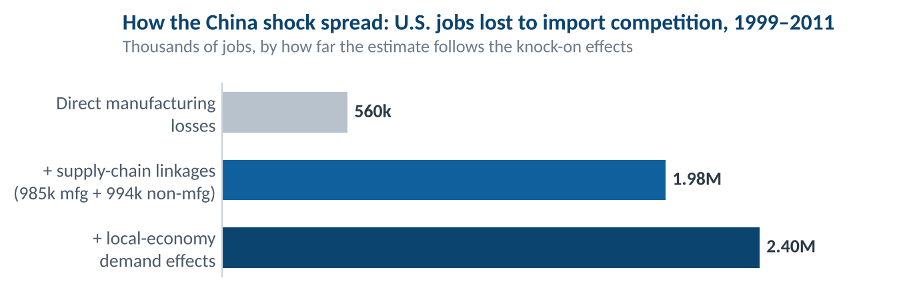 Figure 1. Source: Acemoglu, Autor, Dorn, Hanson & Price (2016) [1].
In the hardest-hit regions, wages and labor-force participation stayed depressed, and unemployment stayed elevated, for at least a full decade [2]. A later follow-up found that most of the lost manufacturing jobs were absorbed not by people moving to new work elsewhere, but by fewer people working at all [3].
Figure 2. Source: Autor, Dorn & Hanson, "On the Persistence of the China Shock" (2021) [3].
Yet the national economy kept growing. Goods got cheaper. Work shifted toward services, technology, healthcare and logistics. Both things were true at the same time: aggregate success, local devastation.
That is the first lesson, and it is well known. The second is less so.
The doom argument about AI says: the machine doesn't buy anything. But from America's point of view, the Chinese factory worker didn't buy much American output either. Her wages became Chinese consumption and Chinese savings, and a large share of those savings flowed back into U.S. financial assets. By 2004, the U.S. current account deficit had reached about $635 billion, roughly 5.5% of GDP [4].
Figure 3. Source: Bernanke (2005) [4].
So how did American demand hold up while income leaked abroad? Partly through credit. Research by Mian, Straub and Sufi shows that after 1982 the top 1% saved a rising share of their income — over 50% of disposable income on average — while the bottom 99% borrowed to keep spending, financing extra outlays of about 1.3% of national income every year [5]. A meaningful part of that borrowing went into housing. We know how that ended in 2008.
Figure 4. Source: Mian, Straub & Sufi [5].
After 2008, the borrowing didn't stop. It changed hands. Households deleveraged: their debt fell from about 100% of GDP at the 2007–08 peak to about 67% in early 2026 [24]. The government took over. Federal debt held by the public rose from about 35% of GDP in 2007 to just over 100% in 2026 [25]. Meanwhile the Federal Reserve held interest rates near zero for most of a decade and grew its balance sheet from about $870 billion to nearly $9 trillion [26] — which lifted the value of everything owners already held.
Figure 5. Source: BIS/FRED household debt to GDP (peak Q4 2007; Q1 2026) [24]; EconoFact federal debt held by the public (2007; March 2026) [25].
"Globalization didn't collapse the economy" is true over twenty years. It is not true of 2008. The demand gap was real; it was covered with debt rather than closed — households' until 2008, the government's since.
That is the rehearsal. AI could run the same play at greater scale.
Follow the money
Take an illustrative company with 1,000 administrative staff at a fully loaded $100,000 each — $100 million a year. Suppose AI lets it run with 400 people plus $15 million of software and compute, with the same output. It saves $45 million.
The money doesn't vanish. It becomes some mix of lower prices, higher profits, new investment, better pay for the remaining staff, and taxes. In accounting terms, income is redistributed, not destroyed.
But the mix matters enormously, and it is not set by technology. It is set by market structure and ownership.
- Prices only fall if competition forces them to. Average markups in U.S. public companies rose from about 21% above marginal cost in 1980 to 61% in 2016 [6]. In concentrated markets, savings tend to stay as margin.
Figure 6. Source: De Loecker, Eeckhout & Unger (2020) [6].
- Labor's slice is already at a record low. Labor's share of U.S. nonfarm business output hit 52.8% in Q2 2026, the lowest since the series began in 1947 [7]. AI did not cause that; it is the starting point AI arrives into.
Figure 7. Source: BLS, nonfarm business labor share (index series rescaled to the published 52.8% Q2 2026 level) [7].
- Profits flow to a narrow base. The top 10% of U.S. households by wealth hold about 88% of corporate equities and mutual funds; the bottom half holds 0.6% [8].
Figure 8. Source: Federal Reserve Distributional Financial Accounts, Q2 2026 [8]. Shares may not sum to 100% due to rounding.
- Stock gains have come mostly from redistribution, not growth. From 1989 to 2017, 40% of the rise in the real value of U.S. corporate equity came from income shifting from workers to shareholders. Only 25% came from economic growth; lower risk premia (21%) and lower interest rates (14%) made up the rest [27]. A separate Federal Reserve study finds that lower interest costs and corporate tax rates explain over 40% of real corporate profit growth from 1989 to 2019 [28].
Figure 9. Source: Greenwald, Lettau & Ludvigson [27].
To be fair to the machine, it does spend. Amazon, Microsoft, Alphabet and Meta planned roughly $700 billion of capital spending in 2026 [9], and that pays electricians, builders, chipmakers and utilities. The precise worry is not that machines don't consume. It is that the people who own the machines spend a smaller share of each extra dollar than the people they replace.
That is a distribution problem, not a production problem. It is also not new.
Where new work comes from
The optimists have strong evidence too. About 60% of U.S. jobs in 2018 were in occupations that did not exist in 1940 [10]. New work keeps getting invented.
Figure 10. Source: Autor, Chin, Salomons & Seegmiller (2024) [10].
But two pieces of history sharpen the story.
Demand has to be elastic. James Bessen's study of textiles, steel and automobiles found the same arc in each: automation first raised employment, because falling prices unlocked huge new demand — then, once the market was saturated, the same productivity gains cut jobs [11]. AI will follow that arc task by task. If legal advice falls from $10,000 to $1,000, millions of people who never hired a lawyer may start. If compliance filing gets cheaper, nobody files twice.
Economies adapt across cohorts, not within careers. ATMs did not eliminate bank tellers; teller jobs grew as banks opened more branches and reshaped the role [12]. Today, the same occupation stands at about 339,000 jobs and is projected to shrink 13% over the next decade [13]. Same technology, different phase. When AT&T automated telephone switching, young women entering the workforce found other jobs — but incumbent operators were more likely, a decade on, to be in lower-paying work or out of work [14].
The task view
Daron Acemoglu and Pascual Restrepo give the cleanest framework. Technology does three things: it displaces workers from tasks, it creates new tasks, and it raises productivity. Wages depend on the balance. Their estimate: automation accounted for 50–70% of the change in the U.S. wage structure between education groups from 1980 to 2016 [15]. They also warn about "so-so automation" — technology good enough to replace a worker but not good enough to raise productivity much. Self-checkout, not the steam engine.
The IMF's estimate of exposure is often quoted: about 60% of jobs in advanced economies are exposed to AI, and roughly half of those may benefit from it rather than be replaced [16]. Less often quoted is its conclusion that, in most scenarios, AI will likely worsen overall inequality.
Figure 11. Source: IMF (2024) [16].
Speed is the variable
The China shock unfolded over about a decade and still left scars that lasted another decade.
Generative AI is moving faster. Within two years of ChatGPT's launch, about 40% of working-age U.S. adults were using it — a faster uptake than either the PC or the internet [17].
Figure 12. Source: Bick, Blandin & Deming [17].
The early labor-market evidence is real but mixed:
- Stanford researchers found a 13% relative decline in employment for 22–25-year-olds in the most AI-exposed occupations, concentrated where AI automates rather than augments [18].
- The Dallas Fed found that recent graduates from more AI-exposed majors saw lower employment rates and about 5% lower first-year earnings [19].
- The New York Fed found job postings show little sign of a distinct AI-driven drop, and that the decline in exposed occupations began before ChatGPT [20].
Figure 13. Sources: [18], [19], [20].
Forecasts range just as widely. Anthropic's CEO has warned AI could eliminate half of entry-level white-collar jobs and push unemployment to 10–20% within one to five years [21]. Acemoglu estimates the productivity gain at no more than about 0.66% of total factor productivity over ten years [22]. Korinek and Suh show both outcomes are possible in the same model: if automation is gradual, wages can keep rising; if it outruns the creation of new work and new capital, wages can collapse [23].
The honest reading: we have felt a tremor, not an earthquake.
The question that matters
So the useful question is not "Will GDP collapse because nobody has a job?" It probably won't. Production is not the constraint.
It is this: will the economy create new uses for human work, and new channels for the gains to reach households, faster than AI erodes the value of existing tasks?
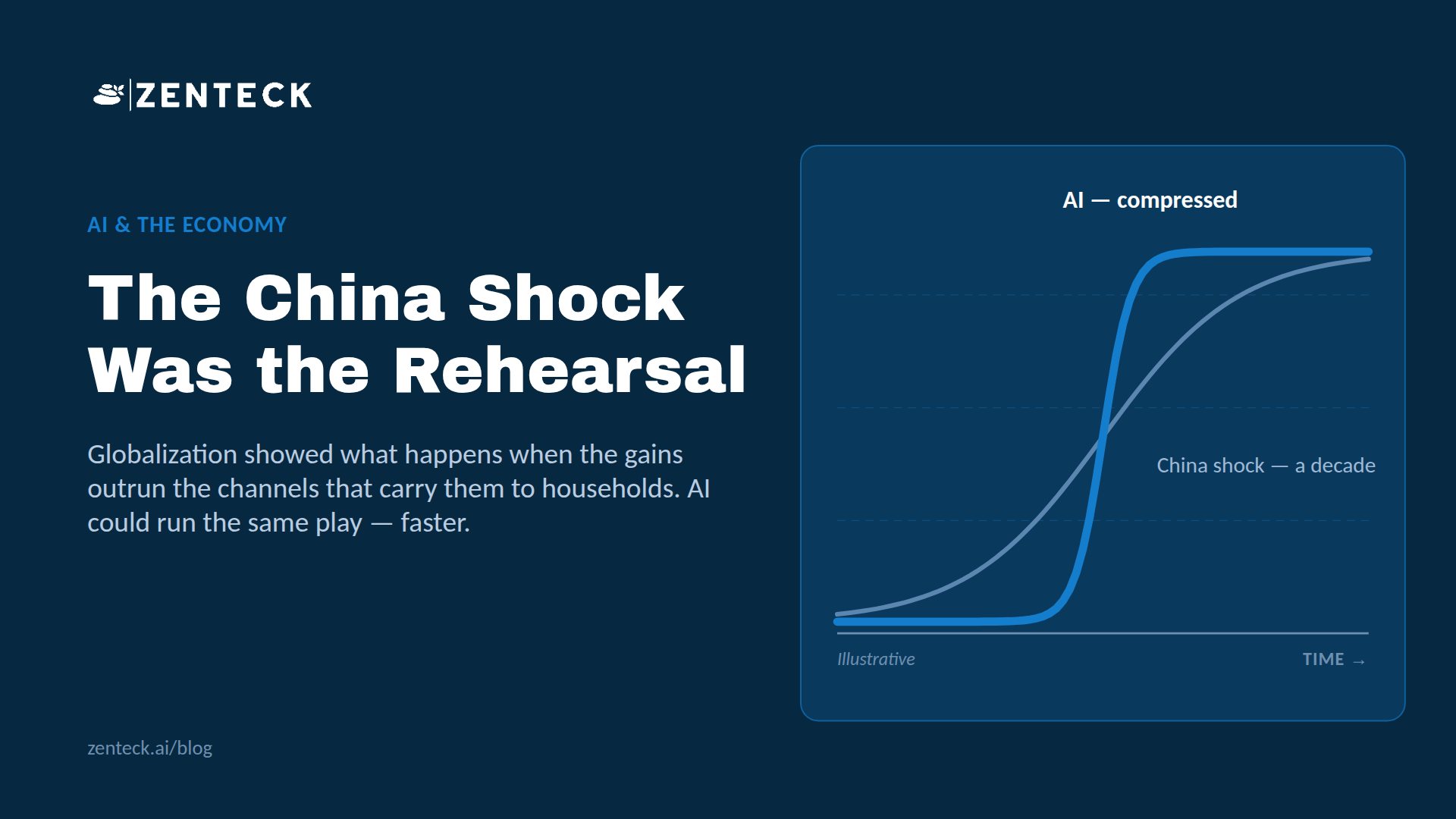
If yes, AI looks like globalization stretched over thirty years — painful in places, positive overall. If no, it looks like globalization compressed into five, and the demand gap gets covered the way it was last time: with debt, until it isn't.
Much of that answer is decided in places that rarely think of themselves as macroeconomic actors: individual companies. A CEO looking at AI can ask "how many roles can we remove?" or "what can we now build that was never economic before?" Both are rational for one firm. Only the second, done at scale, creates the new work and new demand the optimists are counting on.
Globalization gave every company access to a billion new workers. AI gives every company access to cheap cognitive labor. Last time, we mostly used the gift to cut cost and left the distribution problem for later. Later arrived in 2008.
We have the rehearsal on tape. It would be a shame not to watch it.
References
1. Acemoglu, Autor, Dorn, Hanson & Price, "Import Competition and the Great U.S. Employment Sag of the 2000s," Journal of Labor Economics (2016). NBER Digest summary: https://www.nber.org/digest/dec14/w20395.html
2. Autor, Dorn & Hanson, "The China Shock: Learning from Labor-Market Adjustment to Large Changes in Trade," Annual Review of Economics 8 (2016). https://www.nber.org/papers/w21906
3. Autor, Dorn & Hanson, "On the Persistence of the China Shock," Brookings Papers on Economic Activity (2021). https://www.nber.org/papers/w29401
4. Ben S. Bernanke, "The Global Saving Glut and the U.S. Current Account Deficit," Federal Reserve Board speech, March 10, 2005. https://www.federalreserve.gov/boarddocs/speeches/2005/200503102/
5. Mian, Straub & Sufi, "The Saving Glut of the Rich," NBER Working Paper 26941. https://www.nber.org/papers/w26941
6. De Loecker, Eeckhout & Unger, "The Rise of Market Power and the Macroeconomic Implications," Quarterly Journal of Economics 135(2) (2020). https://academic.oup.com/qje/article/135/2/561/5714769
7. U.S. Bureau of Labor Statistics, "Labor share at its lowest level, 52.8 percent, in second quarter 2026," The Economics Daily. https://www.bls.gov/opub/ted/2026/labor-share-at-its-lowest-level-52-8-percent-in-second-quarter-2026.htm
8. Federal Reserve Distributional Financial Accounts via FRED, Q2 2026: top 1% (50.9%) https://fred.stlouisfed.org/series/WFRBST01122 ; 90th–99th percentile (37.2%) https://fred.stlouisfed.org/series/WFRBSN09149 ; bottom 50% (0.6%) https://fred.stlouisfed.org/series/WFRBSB50203
9. Yahoo Finance, "Hyperscalers Hit $700 Billion in 2026 AI Spending Plans," May 1, 2026. https://finance.yahoo.com/sectors/technology/articles/hyperscalers-hit-700-billion-2026-111243744.html
10. Autor, Chin, Salomons & Seegmiller, "New Frontiers: The Origins and Content of New Work, 1940–2018," Quarterly Journal of Economics (2024). MIT News summary: https://news.mit.edu/2024/most-work-is-new-work-us-census-data-shows-0401
11. James Bessen, "Automation and Jobs: When Technology Boosts Employment," Economic Policy (2019). VoxEU summary: https://cepr.org/voxeu/columns/automation-and-jobs-when-technology-boosts-employment
12. James Bessen, Learning by Doing (Yale, 2015), as summarized in "ATMs and a Rising Number of Bank Tellers?" https://conversableeconomist.com/2015/03/03/atms-and-a-rising-number-of-bank-tellers/
13. U.S. Bureau of Labor Statistics, Occupational Outlook Handbook: Tellers. https://www.bls.gov/ooh/Office-and-Administrative-Support/Tellers.htm
14. Feigenbaum & Gross, "Answering the Call of Automation: How the Labor Market Adjusted to Mechanizing Telephone Operation," NBER Working Paper 28061. https://www.nber.org/papers/w28061
15. Acemoglu & Restrepo, "Tasks, Automation, and the Rise in U.S. Wage Inequality," Econometrica (2022). MIT News summary: https://news.mit.edu/2022/automation-drives-income-inequality-1121
16. Kristalina Georgieva, "AI Will Transform the Global Economy. Let's Make Sure It Benefits Humanity," IMF Blog, January 14, 2024; and Cazzaniga et al., "Gen-AI: Artificial Intelligence and the Future of Work," IMF Staff Discussion Note SDN/2024/001. https://www.imf.org/en/Blogs/Articles/2024/01/14/ai-will-transform-the-global-economy-lets-make-sure-it-benefits-humanity
17. Bick, Blandin & Deming, "The Rapid Adoption of Generative AI," NBER Working Paper 32966. https://www.nber.org/papers/w32966
18. Brynjolfsson, Chandar & Chen, "Canaries in the Coal Mine? Six Facts about the Recent Employment Effects of Artificial Intelligence," Stanford Digital Economy Lab (August 2025). https://siepr.stanford.edu/publications/working-paper/canaries-coal-mine-six-facts-about-recent-employment-effects-artificial
19. Dodini & Smith, "AI plays a role in weak labor market for college graduates," Federal Reserve Bank of Dallas, September 22, 2026. https://www.dallasfed.org/research/economics/2026/0922
20. Federal Reserve Bank of New York, "Do Job Postings Show Early Labor-Market Effects of AI?" Liberty Street Economics, May 2026. https://libertystreeteconomics.newyorkfed.org/2026/05/do-job-postings-show-early-labor-market-effects-of-ai/
21. Axios, "Behind the Curtain: A white-collar bloodbath," May 28, 2025. https://www.axios.com/2025/05/28/ai-jobs-white-collar-unemployment-anthropic
22. Daron Acemoglu, "The Simple Macroeconomics of AI," NBER Working Paper 32487 (2024). https://www.nber.org/papers/w32487
23. Korinek & Suh, "Scenarios for the Transition to AGI," NBER Working Paper 32255 (2024). https://www.nber.org/papers/w32255
24. Bank for International Settlements via FRED, "Household Debt to GDP for United States" (HDTGPDUSQ163N). https://fred.stlouisfed.org/series/HDTGPDUSQ163N
25. EconoFact, "Has the national debt exceeded 100% of GDP?" (2026), citing U.S. Treasury and BEA data. https://econofact.org/factbrief/fact-check-has-the-national-debt-exceeded-100-of-gdp
26. Christopher J. Waller, "Demystifying the Federal Reserve's Balance Sheet," Federal Reserve Board speech, July 10, 2025. https://www.federalreserve.gov/newsevents/speech/waller20250710a.htm
27. Greenwald, Lettau & Ludvigson, "How the Wealth Was Won: Factor Shares as Market Fundamentals," NBER Working Paper 25769. https://www.nber.org/papers/w25769
28. Michael Smolyansky, "End of an Era: The Coming Long-Run Slowdown in Corporate Profit Growth and Stock Returns," Federal Reserve FEDS (June 2023). https://www.federalreserve.gov/econres/feds/end-of-an-era-the-coming-long-run-slowdown-in-corporate-profit-growth-and-stock-returns.htm